
Local SEO usually needs enough time for Google to process changes, for a business to build clearer local relevance, and for real demand to produce measurable calls, forms or bookings. I use months 1, 3 and 6 as review points, not promises. This guide shows Ontario owners what I review and when I change course.
My short answer: I expect setup and early visibility signals in the first month, a useful trend by about month 3, and enough evidence for a serious keep, fix or stop decision by about month 6. Some businesses move sooner. Others take longer. No responsible SEO can promise a date or a position because the starting point, market, location, competition and work all differ.
Research note: I prepared this guide using current Google Search Central, Google Business Profile, Search Console, Google Analytics and Canadian privacy guidance. A recent r/localseo discussion about disappointing four-month results helped frame the owner question. Reddit informed the language and concerns, not the factual recommendations.
Why I don't give one fixed local SEO timeline
After more than 15 years in marketing, including agency-side SEO, GEO and paid advertising for local businesses, I've learned to separate a timeline from a guarantee. A timeline is a review structure. A guarantee pretends the marketer controls the result.
Google's own SEO Starter Guide says some changes may show in a few hours while others can take several months, and it recommends waiting a few weeks before assessing whether work helped. Google also says that not every change produces a noticeable search impact. That is why I don't treat a page edit on Monday as a ranking test on Friday.
Local search adds another variable. Google says local results are mainly based on relevance, distance and prominence. I can improve how clearly a business describes its services, strengthen its website and keep its profile accurate. I cannot move the searcher closer to the business, remove every competitor or pay Google for a better organic local position.
What changes the timeline for an Ontario business?
I look at five conditions before I set expectations.
- The starting point. An established business with a verified Google Business Profile, a crawlable site and accurate information starts in a different place than a new company with a new domain and inconsistent details.
- The service and local demand. Ranking improvements cannot create searches that do not exist. I check whether people in the service area search for the offer, how they describe it and whether the business can profitably serve that demand.
- The competitive market. A specialized service in a smaller Ontario market can behave differently from a crowded legal, dental, home-service or fitness category in Toronto, Hamilton, Mississauga or Ottawa.
- The type and quality of work. Fixing a blocked page, correcting a profile or publishing a genuinely useful service page is different from making cosmetic edits that do not improve relevance, trust or usability.
- The conversion path. Better visibility is not the same as better business. If calls go unanswered, forms fail, booking is confusing or the offer is unclear, more impressions may never become qualified enquiries.
This is also why I audit the system before I estimate the pace. My earlier guides explain how I approach local citation accuracy, Google review requests, local link building and multi-location pages. None is a magic lever by itself. The pieces have to support one clear business entity and a useful customer experience.
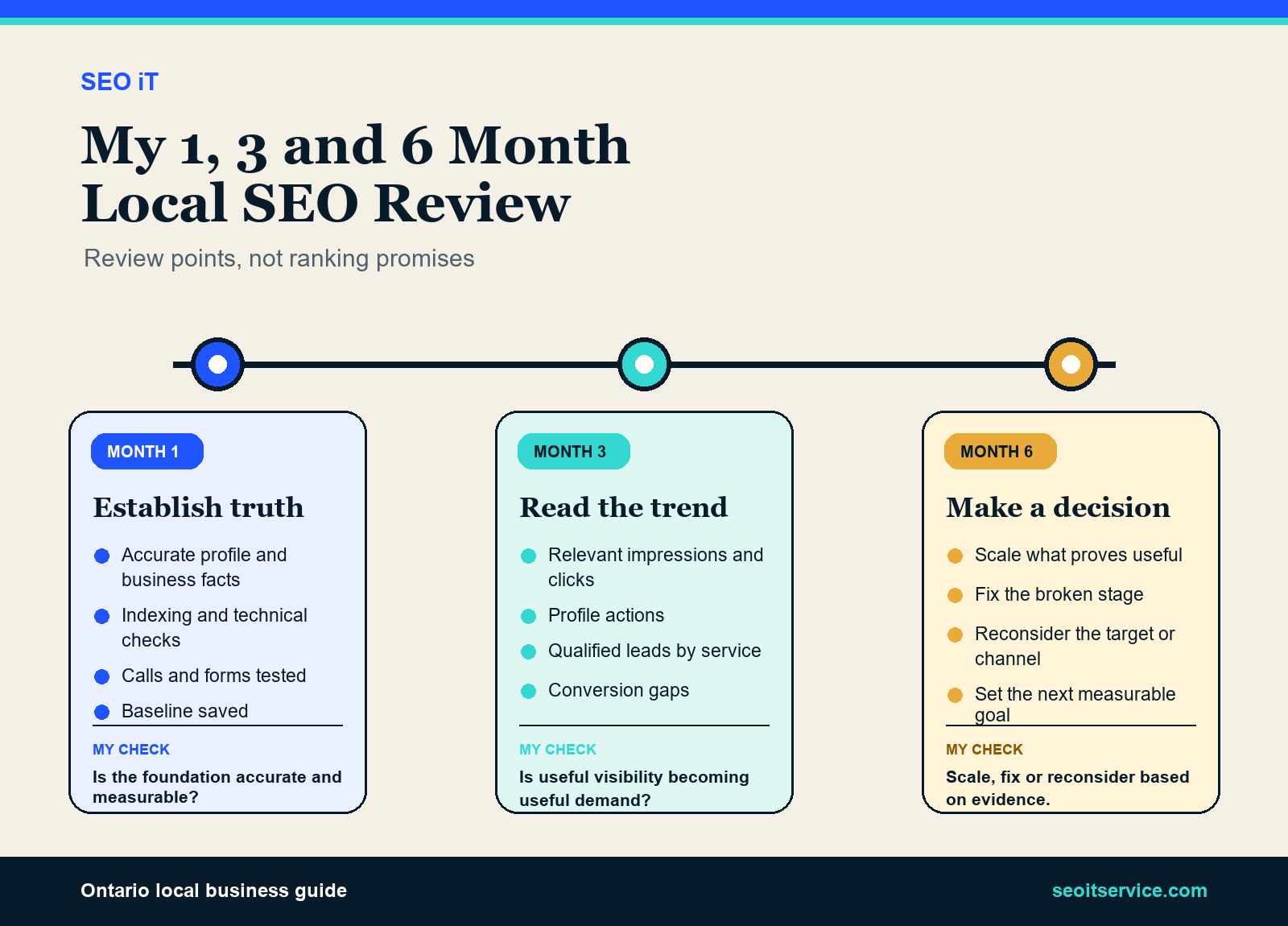
What I expect in month 1
Month 1 is for establishing truth. I want to know what Google can access, what the business is eligible to show, what customers can do and what the current data actually says.
What should be completed
- Confirm Google Business Profile ownership, verification, categories, address or service-area setup, hours, services, phone and website link.
- Confirm the site can be crawled and indexed, important pages have unique purposes, and service and location facts match the real business.
- Set a baseline in Google Search Console, Google Business Profile performance and analytics.
- Test calls, contact forms, booking links and thank-you pages on mobile and desktop.
- Identify the small set of service and location queries that matter commercially.
- Prioritize fixes by customer and business value, not by the number of items in an audit export.
What I watch
Early evidence can include corrected indexing, more relevant impressions, new non-branded queries, better coverage of core services, accurate profile information and working conversion tracking. Those are useful signs, but I do not present them as booked revenue.
Search Console defines impressions, clicks, click-through rate and average position in specific ways. Google also warns that average position is complex and recommends watching changes over time instead of treating one number as a universal rank. I use the official Search Console metric definitions so a report does not turn an average into a false claim.
My month 1 decision: Is the foundation now accurate, measurable and aligned with real services? If the answer is no, I don't blame time. I fix the foundation.
What I expect by month 3
By month 3, I want a trend rather than a dramatic screenshot. The work should have had time to be crawled, processed and tested against real searches, although the market may still be noisy.
What I compare
- Service and location query impressions against the baseline.
- Clicks and click-through rate for the pages meant to attract enquiries.
- Google Business Profile search terms and actions, including calls, website clicks, directions or bookings when those metrics apply.
- Calls, forms and bookings by source, followed by whether those enquiries were relevant, serviceable and worth pursuing.
- Performance by page and service, not just a site-wide total.
Google's Business Profile performance documentation explains that profile owners can review views, searches and customer interactions. A call metric records a click on the call button, not a completed conversation or a sale. A website click is not automatically a lead. I carry the measurement through to the action the business actually values.
I also use Search Console comparisons carefully. Google recommends focusing more on trends in impressions and clicks than on position alone. Its Performance report guidance shows how to filter by query or page and compare time periods. I normally compare like with like and note seasonality, promotions, site changes and offline events that could distort the story.
My month 3 decision: Is the business earning more relevant visibility and are useful enquiries beginning to follow? If visibility is improving but enquiries are not, I inspect intent, offer, page clarity and conversion friction. If nothing is moving, I revisit eligibility, indexing, targeting, competition and whether the work was substantial enough.
What I expect by month 6
Month 6 is where I want enough evidence for a business decision. That does not mean every business should be at the top of a map pack. It means I should be able to explain what changed, what did not, why the current direction is credible and what the next investment should achieve.
At this point, I separate three possible conclusions.
| Decision | What the evidence looks like | What I do next |
|---|---|---|
| Scale | Relevant visibility and qualified enquiries are trending up, and the business can serve more demand. | Strengthen the pages, locations and topics already proving useful, then expand carefully. |
| Fix | Visibility has improved, but conversion, lead quality, tracking or operations are weak. | Repair the broken stage before buying more traffic or publishing more content. |
| Reconsider | Relevant demand is too small, competition is economically unrealistic, eligibility is limited, or six months of credible work produced no useful direction. | Change the target, offer, market or channel. I do not keep a retainer alive just because SEO can take time. |
Google's guidance on core updates makes the same larger point: some improvements may take days, while broader site-level changes can take several months, and there is no guarantee of noticeable impact. Waiting can be rational. Waiting without a measurable hypothesis is not.
The scorecard I use instead of a single ranking
I use a short scorecard that connects search visibility to the business.
- Coverage: Are the right service and location pages indexed and eligible?
- Relevance: Are impressions growing for queries that match what the business actually sells?
- Engagement: Are people clicking the right pages and profile actions?
- Enquiries: Are calls, forms and bookings increasing from organic search and the Business Profile?
- Quality: Are those enquiries from the right areas, for the right services and within the business's capacity?
- Commercial value: Are qualified enquiries becoming appointments, estimates or sales at a level that justifies continued work?
I keep privacy in the design. The Office of the Privacy Commissioner of Canada's Privacy Guide for Businesses covers meaningful consent, limiting collection and safeguards. Google Analytics also prohibits sending information it can recognize as personally identifiable, including personal email addresses and phone numbers. I check form events, URLs and campaign parameters against Google's PII guidance, and I use stricter review where health or other sensitive information may be involved.
When I would change course before month 6
I do not use a six-month framework as an excuse to ignore obvious problems. I act sooner when:
- the business is ineligible for the profile or location strategy being used;
- important pages are blocked, broken, duplicated or aimed at services the business does not provide;
- tracking is counting spam, staff tests or unrelated enquiries as success;
- the campaign targets places the business cannot profitably serve;
- the phone is not answered, forms fail or enquiries sit untouched;
- the work consists mainly of reports, minor edits or content volume without a clear customer purpose.
If you're evaluating an outside provider, my questions to ask an SEO agency can help you test whether the proposed timeline has a diagnosis, milestones, ownership and an exit path behind it.
Frequently asked questions
Can local SEO work in one month?
Some useful changes can appear within a month, especially when a technical problem, inaccurate profile or missing page is corrected. I still would not promise a stable ranking or a reliable lead pattern in 30 days. I use the first month to establish access, fix high-impact issues and look for early directional signals.
Why might local SEO show little progress after four months?
I check whether the right things are being measured before I call it failure. The problem may be weak demand, unrealistic geography, strong competition, an eligibility issue, poor indexing, generic content, inaccurate business information or conversion friction. It may also be that impressions are changing while the report focuses only on one average position.
How do I know local SEO is working before leads increase?
I look for leading signals that connect to commercial intent: important pages indexed, more relevant non-branded queries, growing impressions for priority services and useful Business Profile interactions. I label these as leading indicators, not revenue. Calls, forms, bookings and qualified opportunities remain the stronger business evidence.
How often should I review local SEO performance?
I monitor access, errors and conversion tracking continuously, but I avoid making strategy changes from daily ranking noise. A monthly operating review and a deeper comparison at months 1, 3 and 6 usually gives me a clearer view. Seasonal businesses should compare against the right prior period, not just the previous month.
Should I stop local SEO if month 6 is disappointing?
Not automatically. I first decide whether the issue is visibility, conversion, lead quality, market demand or measurement. Then I choose to scale, fix or reconsider. What I would not do is keep repeating the same work without a reason to believe the next period will be different.
My bottom line
When an Ontario business asks me how long local SEO takes, I don't give a countdown. I give review points. Month 1 should create an accurate and measurable foundation. Month 3 should reveal a useful direction. Month 6 should support a clear decision based on relevant visibility, qualified enquiries and commercial value.
If you want a second set of eyes on your starting point, my Hamilton SEO service explains how I approach the foundation, and you can contact SEO iT for a practical conversation about what is realistic for your market. There is no pressure to start with a retainer. The first useful step is understanding what should change and how you will know.