
When a B2B owner asks me whether Google Ads or LinkedIn Ads is better, my honest answer is: better for what?
Google and LinkedIn do not reach people in the same mindset. Google Search can put your business in front of someone who is actively looking for a solution. LinkedIn can put your business in front of a specific type of professional, even when that person is not searching.
That difference matters more than any generic comparison of click costs or audience size.
I have worked in marketing for more than 15 years, including agency work, white-label campaign management, paid advertising for local businesses, and marketing leadership inside a SaaS company. One lesson has stayed consistent: the platform is rarely the strategy. The strategy starts with the buyer, the problem they are trying to solve, and how they normally find help.
This guide is for B2B companies in Ontario that need a practical answer.
The short answer
If people already search for your service, I would usually test Google Search first.
If you need to reach people by job function, seniority, industry, company size, or named accounts, I would usually test LinkedIn first.
If the sale is valuable, the buying cycle is long, and you have enough budget and measurement capacity, the strongest plan may use both. Google captures existing demand. LinkedIn helps create familiarity and reach more of the buying committee.
| Situation | Better starting point |
|---|---|
| Buyers actively search for the service | Google Search |
| You must reach a specific job role | LinkedIn Ads |
| You sell to a short list of target accounts | LinkedIn Ads |
| You need phone calls or quote requests now | Google Search |
| Your offer requires education before a buyer searches | LinkedIn Ads |
| You have a longer sales cycle and reliable CRM tracking | A coordinated Google and LinkedIn strategy |
Before choosing a platform, I look at search demand, deal value, sales capacity, geography, the offer, and the quality of the tracking.
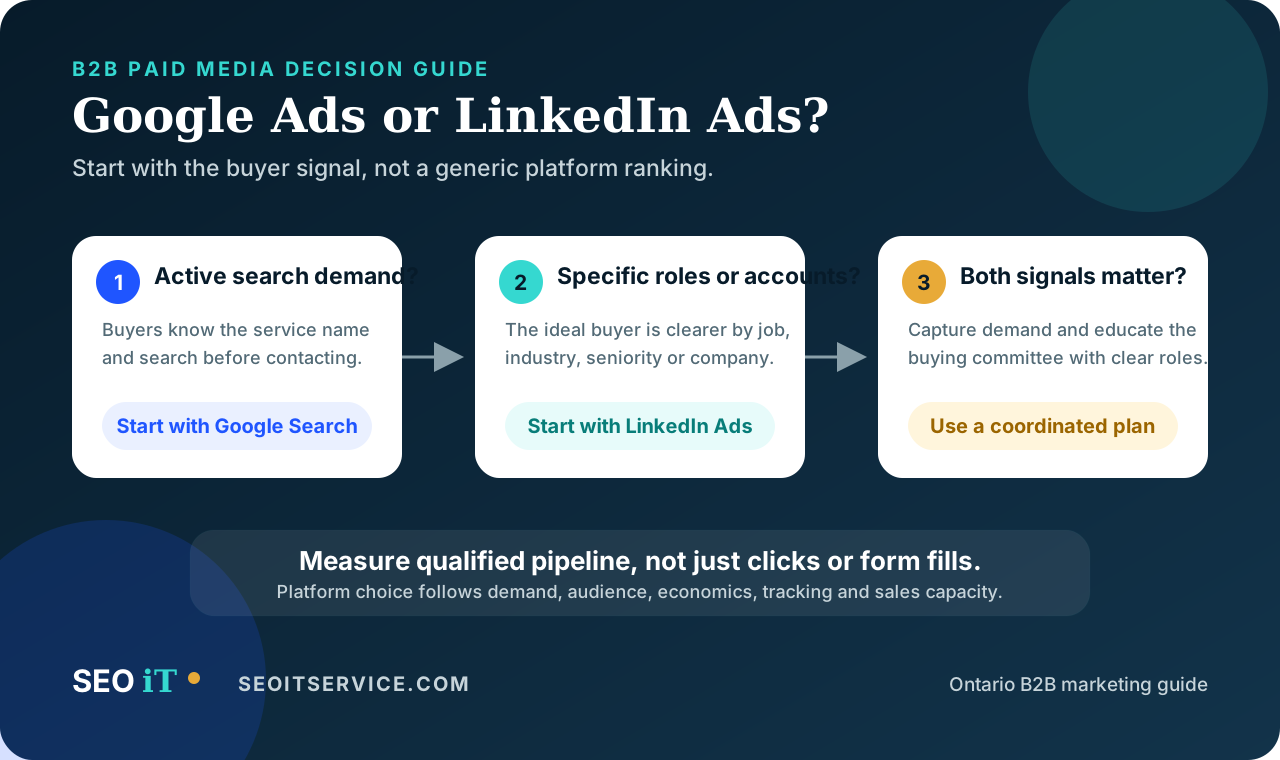
The real difference is intent versus professional context
Google Search is built around a query. A buyer might search for “managed IT services Hamilton,” “commercial cleaning company Toronto,” or “ISO consultant Ontario.” The words reveal a problem and, sometimes, a strong intent to hire.
Google confirms that Search campaigns are designed to reach people while they are searching for the products or services an advertiser offers. Search ads may appear around Google search results and, depending on campaign settings, on search partner properties.
LinkedIn starts with the person or account you want to reach. Its targeting options include professional attributes and Matched Audiences. A company can build audiences using criteria such as job function, seniority, industry, or company information, and can also use eligible company lists, contact lists, website visitors, and ad engagement.
This creates two very different opportunities:
- Google lets me respond to demand.
- LinkedIn lets me define the professional audience.
Neither is automatically more “B2B.” The right choice depends on whether the buyer is already looking.
When I would start with Google Ads
I lean toward Google Search when the buyer knows what the service is called and is likely to search before contacting a provider.
For example, a facilities manager may search for a commercial roofing contractor, or an owner may search for outsourced IT support. Those searches provide a useful signal that LinkedIn targeting alone cannot.
Google is often the more direct starting point when:
- Your service already has meaningful search demand.
- A prospect can understand the offer from a short landing page.
- The location served is clearly defined.
- A call, consultation, quote, or demo request is the next logical step.
For a local Ontario business, location settings deserve extra attention. Google allows advertisers to target countries, regions, cities, radius areas, and some location groups. It also explains that location matching relies on several signals and is not perfectly accurate. I review the location report rather than assuming a Hamilton, Toronto, or Ontario setting is doing exactly what its label suggests.
I also review search terms and build negative keyword lists. Clicks from job seekers, students, do-it-yourself searches, or consumers outside the market can make an account look busy without creating sales value. Google says negative keywords can prevent ads from showing for excluded search terms.
Where Google Ads can go wrong
The common problems I see are:
- Keywords are too broad for the offer.
- Ads send everyone to a generic homepage.
- Search partners or other networks are enabled without being reviewed separately.
- Location settings are broader than the actual service area.
- Every form submission is treated as a good lead.
- Phone calls, qualified opportunities, and closed sales are not connected back to the campaign.
I would rather run a focused Search campaign than spread a modest budget across Search, Display, Performance Max, and several automated recommendations.
Performance Max can be useful, but it depends heavily on accurate conversion goals, good creative assets, and enough meaningful data. Google describes it as a goal-based campaign that uses automation across its channels. For B2B lead generation, I do not want the system optimizing toward spam forms or unqualified enquiries. The conversion setup has to come first.
When I would start with LinkedIn Ads
I lean toward LinkedIn when the audience definition is clearer than the search query.
Imagine a company that sells compliance software to directors of operations at mid-market manufacturers. The relevant searches may be limited, vague, or dominated by research. On LinkedIn, the company can build an audience around professional and company attributes instead.
LinkedIn is often the more logical starting point when:
- You need to reach a specific function or level of seniority.
- Your sales team has a target-account list.
- Several people influence the purchase.
- The market needs education before it searches.
- Your content can help a buyer understand or evaluate the problem.
- The deal value can support a longer nurturing process.
LinkedIn offers Sponsored Content, Sponsored Messaging, Text Ads, Dynamic Ads, and other formats. I usually choose the format after deciding what the prospect should learn or do.
A single image ad can introduce a clear point of view. A document ad can preview a guide or case study in the feed. A Lead Gen Form can capture information directly on LinkedIn and prefill profile details.
Where LinkedIn Ads can go wrong
The most common LinkedIn mistake is confusing precise targeting with purchase intent.
A person may have the right title and still have no interest in buying today. Precise targeting will not rescue a weak offer.
Other common problems include:
- An audience is narrowed until delivery becomes difficult.
- Creative talks about the company instead of the buyer's problem.
- Every ad uses the same generic “book a demo” offer.
- Lead Gen Forms collect names but not enough context to qualify interest.
- Leads are downloaded manually and followed up days later.
- Campaign reporting stops at cost per lead.
LinkedIn Lead Gen Forms can prefill information from a member's profile. I judge them by what happens after submission, not by form volume alone.
Which platform costs less?
There is no reliable universal answer.
The cheaper click can produce the more expensive customer. Auction costs also change with the audience, market, competition, bid strategy, ad quality, location, and time.
I do not build a forecast from a broad industry average. I work backward from the business.
For example:
- What is an acceptable cost to acquire a new customer?
- How many qualified opportunities normally become customers?
- How many raw leads become qualified opportunities?
- How long does that process take?
- Can the sales team follow up consistently?
Those answers give me a working ceiling for lead acquisition.
A small budget split across too many campaigns can produce an inconclusive result. If the market already searches for the service, I would usually fund a focused Google Search test first. If the search demand is weak but the ideal customer profile is clear, I would put the initial test behind a strong LinkedIn audience and offer.
Measurement matters more than the platform choice
B2B advertising gets distorted when the reporting ends at form submissions.
I want to know:
- Which leads matched the ideal customer profile?
- Which leads were accepted by sales?
- Which became opportunities?
- What pipeline value was created?
- Which opportunities closed?
- How long did the process take?
Google supports enhanced conversions for leads, which can use hashed first-party lead information and imported offline outcomes to improve attribution. As of June 2026, Google directs advertisers toward Data Manager for current and future enhanced-conversion and offline-conversion uploads. This is especially relevant for B2B businesses where the meaningful conversion happens after a phone call, qualification step, proposal, or sales process.
LinkedIn also supports multiple conversion data sources, including the Insight Tag, Conversions API, CRM connections, and CSV uploads. Its conversion tools can connect campaign activity with actions beyond a simple ad click.
You do need consistent campaign naming, UTM parameters, working form and call tracking, and a way for sales to mark lead quality. Even a disciplined spreadsheet is better than treating every enquiry as equal.
If customer information is being sent to an advertising platform, review the platform terms and your privacy obligations. This is operational marketing guidance, not legal advice.
How I would use Google and LinkedIn together
I do not automatically recommend a 50/50 budget split. I give each platform a specific job.
A coordinated campaign might work like this:
- Google Search captures buyers already looking for the service.
- LinkedIn introduces a useful guide or point of view to the target market.
- Website visitors and engaged audiences receive follow-up messaging where eligible.
- Sales feedback identifies which campaigns create qualified opportunities.
- Budget moves toward the campaigns producing pipeline, not simply clicks or forms.
For a managed IT provider, Google could target high-intent service searches in its Ontario service area. LinkedIn could promote a practical cyber-risk checklist to operations or technology leaders at suitable companies.
The message should change between platforms. Search copy can be direct because the prospect has already expressed intent. LinkedIn creative usually needs to earn attention before asking for a conversation.
A practical 90-day testing plan
If I were starting with a clean account, I would structure the first three months like this.
Weeks 1 and 2: Build the foundation
- Define the ideal customer, service area, buying roles, and disqualifiers.
- Confirm the offer and landing-page message.
- Set up form, call, and CRM tracking.
- Agree on the definitions of a lead, qualified lead, and opportunity.
- Establish a realistic follow-up process.
If your landing page is slow, vague, or designed for every possible audience, fix that before buying more traffic. Our Hamilton web design service focuses on pages built around a clear action.
Weeks 3 and 4: Launch one focused test
Choose the platform that matches the strongest available signal.
For Google, I would start with a tightly organized Search campaign, relevant ad groups, location controls, negative keywords, and dedicated landing pages.
For LinkedIn, I would start with a clearly defined audience, one useful offer, a small set of creative variations, and a reliable lead-routing process.
Weeks 5 to 8: Improve quality
Review search terms, professional audience data, lead quality, landing-page behaviour, and sales feedback. Pause what is clearly irrelevant. Do not rebuild the campaign every few days because a short window feels uncomfortable.
Weeks 9 to 12: Expand with evidence
Add the second platform only when it has a defined role. Expand keywords, audiences, formats, or automation after the first campaign has produced enough evidence to guide the next decision.
My verdict on Google Ads vs LinkedIn Ads for B2B
Google Ads is usually my first choice when a business wants to capture active demand. LinkedIn Ads is usually my first choice when a business needs to reach a defined professional audience or target-account list.
For many B2B companies, the best long-term answer is not one platform or the other. It is a clear division of labour between them, supported by landing pages, useful content, reliable tracking, and sales feedback.
The part I would not do is choose based on a generic claim that one platform has cheaper clicks or better conversion rates. Your market, offer, geography, sales process, and measurement will decide the result.
If you want help deciding where to start, learn more about our Google Ads management services or contact SEO iT. I can review the demand, audience, tracking, and economics before recommending a campaign.
Official platform sources used for this update
- Google Ads, Choose the right campaign type
- Google Ads, About the Google Search Network
- Google Ads, Target ads to geographic locations
- Google Ads, About negative keywords
- Google Ads, About enhanced conversions for leads
- LinkedIn, Get started with LinkedIn Ads
- LinkedIn, Targeting options for LinkedIn Ads
- LinkedIn, Lead Gen Forms
- LinkedIn, Get started with LinkedIn Conversion Tracking
- LinkedIn, Retargeting with Matched Audiences