
Research note: I prepared this guide using Google’s official documentation, Ahrefs Canada keyword data reviewed in July 2026, and recent practitioner discussions. I used AI-assisted tools to help organize the research and drafting, then checked the recommendations against the linked primary sources.
After more than 15 years working in marketing, I have seen a steady stream of new acronyms arrive with big promises attached. Generative engine optimization is the latest example. There is a useful idea underneath it, but that idea is often buried under new dashboards, new scores and claims that make the work sound more mysterious than it is.
I could see how much uncertainty there was when I reviewed recent discussions in r/SEO. A thread sharing Google’s new guidance had attracted more than 150 upvotes. Another discussion asking whether GEO visibility monitoring is mostly “snake oil” had drawn more than 130 upvotes and 125 comments. I think the question behind both discussions is fair: what actually deserves a local business owner’s time and budget?
When Google published its guide to succeeding in AI search on July 10, 2026, I read it closely. It addresses generative engine optimization (GEO), answer engine optimization (AEO), retrieval-augmented generation and query fan-out. What stood out to me was how practical the guidance is compared with much of the sales language surrounding GEO.
The direct answer
My view is simple: GEO is not a separate shortcut around SEO. When I assess visibility in Google’s AI experiences, I start with crawlable pages, useful and original content, clear business information, trustworthy evidence and a good experience for visitors. I would strengthen those foundations before asking an Ontario local business to buy another visibility tool or rewrite every page for a chatbot.
What I took from Google’s 2026 GEO guidance
I did not find a secret set of AI ranking factors in the guide. Instead, Google explained how its generative search experiences use established Search systems to find and support answers.
I took three practical points from the guide that I would use to shape a local business strategy:
- I still treat AI search as part of core Search. Google says its generative experiences are rooted in the same ranking and quality systems that support regular results.
- I plan for one question to trigger several searches. Through “query fan-out,” Google may break a complex request into related searches, compare the information it retrieves, and assemble a more complete response.
- I focus on source quality. Search systems need pages they can access, understand and use to support a response. In my experience, helpful, specific and credible content has more value than a page created only to target a phrase.
When I plan content for a physiotherapy clinic, I do not start by inventing an “AI page.” I would rather build a useful treatment page that explains who the service is for, what an assessment involves, relevant credentials, realistic recovery factors, fees, location details and how to book. For a locksmith site, I would make the service area, availability and pricing factors easy to understand. For a law firm, I would carefully separate general information from legal advice.
That is the kind of page I want to create because it can help a prospective customer, support a traditional search result and provide useful source material for an AI-generated answer at the same time.
How I think about SEO, AEO and GEO
I do not treat these labels as three unrelated marketing programs. To me, they describe different ways the same useful business information may be discovered and presented.
- When I say SEO, I mean improving how a business is discovered and evaluated in search results.
- When I say AEO, I mean making concise, dependable answers to specific questions easy to find.
- When I say GEO, I mean helping generative systems retrieve, interpret and use accurate information about a business or subject.
Google’s position is that these activities remain part of SEO on Google Search. That matches how I approach the work. Technically sound pages, unambiguous language, original expertise, reliable facts and strong internal links help across all three.
I also checked keyword demand because I wanted to see whether people were actually searching for this terminology. Ahrefs’ Canada database estimated 900 monthly searches for “generative engine optimization,” 500 for “answer engine optimization” and 250 for “AI search optimization” when I reviewed it in July 2026. I also found that commercial local queries remain important. “Local SEO for small business” was estimated at 200 monthly searches with low keyword difficulty, and closely related service phrases collectively represented greater traffic potential.
| Keyword | Monthly volume | Keyword difficulty |
|---|---|---|
| generative engine optimization | 900 | 48 |
| answer engine optimization | 500 | 46 |
| AI search optimization | 250 | Not available |
| local SEO for small business | 200 | 2 |
| local SEO checklist | 200 | 14 |
I do not treat these estimates as forecasts. I use them as directional evidence. They tell me that owners are actively trying to understand AI search, while the underlying need to win local customers through search has not disappeared.
How I plan for query fan-out in local search
When I think through local search intent, I compare a short query such as “physiotherapist Hamilton” with a more conversational question: “Which Hamilton physiotherapy clinic treats runners, offers evening appointments, and can help me understand whether my insurance covers an assessment?”
I expect Google may fan that request out into searches about:
- physiotherapy clinics in Hamilton;
- sports or running-injury treatment;
- evening hours;
- insurance and direct billing;
- professional credentials;
- reviews, location and booking availability.
I do not try to force one sentence to answer everything. I build a connected body of accurate information: a focused service page, practitioner profiles, insurance guidance, location details, frequently asked questions and evidence from real work. I then use internal links to help visitors and search systems move between those pieces.
This is why I rarely recommend leading with generic “What is physiotherapy?” content. That answer already exists on thousands of sites. The local clinic’s real advantage is the information only that clinic can provide.
Seven actions I would prioritize for an Ontario local business
1. I start with crawlability and indexability
My first pass is deliberately unglamorous. I check whether Google can access the page, whether the page is allowed to be indexed, whether the server returns meaningful HTML and whether the content is eligible to appear as a snippet. I also check that important pages are linked from the main navigation or from relevant service pages.
I pay extra attention to JavaScript-heavy and AI-built websites. A page can look complete to a customer while exposing very little useful content in its initial HTML. I check priority pages in Google Search Console and inspect the rendered page, not just the design.
2. I give every core service a useful page
When I write or review a service page, I ask whether it helps a customer decide if the service fits. I explain the problem, who the service is for, the process, important constraints, pricing factors, service area, proof and the next step. I also link to related questions and supporting evidence.
I avoid producing dozens of near-identical city pages with only the place name changed. I do not read Google’s guidance on AI-generated content as anti-AI. I read it as a warning about scaled, low-value content. I would rather publish a smaller set of strong pages than a large collection of thin ones.
3. I publish proof a competitor cannot copy
In my experience, original information is one of a local business’s strongest content assets. I look for material such as:
- before-and-after project explanations, with permission;
- common pricing variables and what changes a quote;
- photos from real jobs, facilities, staff or neighbourhoods;
- expert answers to questions customers ask on the phone;
- service limitations and situations that require another provider;
- local regulations, climate or property conditions that affect the work.
In agency work with lawyers, dentists, physiotherapists and gyms, I have repeatedly seen that the most useful content starts with real customer conversations, not with a keyword list. I use search research to organize demand, but frontline experience supplies the substance.
4. I keep business facts consistent
I make the official name, address or service area, phone number, hours, services and credentials easy to verify. When something changes, I update the website and Google Business Profile, then correct conflicting details on important industry and local listings.
I know consistency is not exciting work, but I have seen how quickly small discrepancies create confusion. An AI answer is not useful if the customer calls an old number or arrives after closing.
5. I answer the question directly
I put a short answer near the question, then add the nuance a customer needs. I use descriptive headings, short paragraphs, lists and tables when they genuinely improve comprehension. To me, this is simply good information design. It is not a reason to chop every paragraph into artificial “AI chunks.”
For example, I would answer “Do you offer emergency locksmith service in Burlington?” directly. Then I would explain the hours, areas covered, what the caller should have ready, pricing factors and any exceptions.
6. I show who created the content
I want readers to know who created the content and why that person is qualified to discuss the subject. Google’s people-first content guidance makes the same “Who, How and Why” point. I use accurate bylines where readers expect them and add an author bio that explains relevant experience. On medical, legal and financial topics, I name an appropriate reviewer and separate general education from individualized advice.
I never invent credentials or add a reviewer who did not actually review the page. In my view, transparent and limited claims build more trust than decorative expertise.
7. I connect the information to a next step
I do not consider visibility complete unless there is a clear path to action. On every priority page, I make the appropriate next step obvious: call, request a quote, book an assessment or ask a question. I also add contextual internal links to related services instead of relying only on the main menu.
That creates a coherent path from discovery to evaluation to conversion. It also helps Search understand how your local SEO pages, service explanations and business proof relate.
What I tell local businesses they can ignore
I appreciate that Google’s guide is unusually direct about several GEO myths. Based on the guidance, I would not rebuild a site around speculative tactics just to chase visibility in Google Search.
| Claim | What to do instead |
|---|---|
| “You need an llms.txt file to rank in Google’s AI answers.” | I keep important pages crawlable, indexable and useful. Google says no special AI file is required. |
| “Every paragraph must be rewritten into tiny chunks.” | I organize information for people and use headings or concise answers where they improve clarity. |
| “Add as much schema as possible.” | I use supported structured data that accurately matches visible content. I do not treat schema as a substitute for substance. |
| “Pay for mentions anywhere to build AI authority.” | I focus on relevant coverage, reviews and citations earned through real relationships and good work. |
| “A visibility score proves the strategy works.” | I track a stable set of representative queries, qualified visits, calls, forms, bookings and revenue. |
I still use structured data when it helps systems interpret a page, but I make sure it matches what visitors can see. I do not know of any special schema type that guarantees inclusion in an AI response.
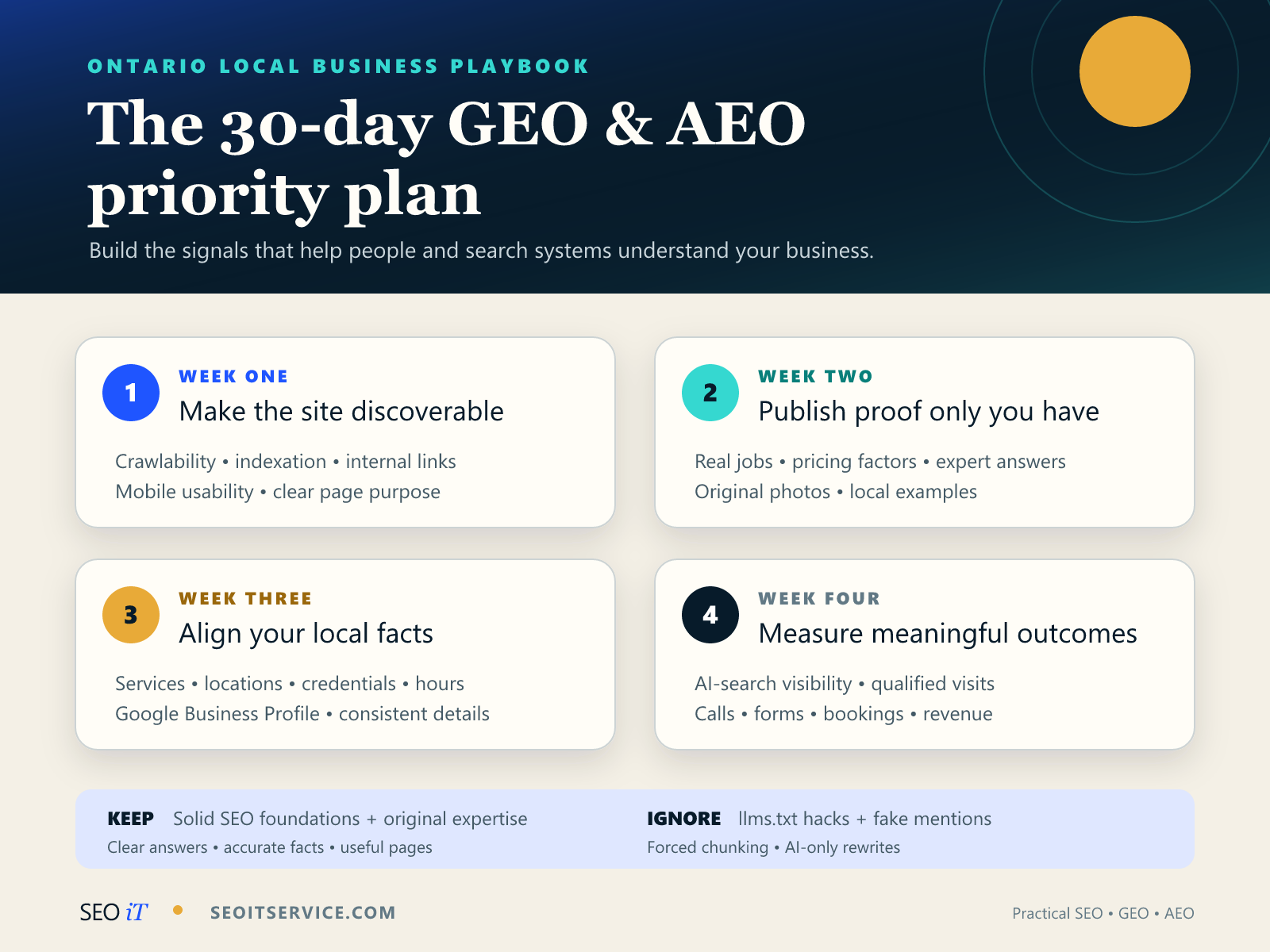
The 30-day GEO and AEO plan I would use
Week 1: make the site discoverable
I would choose the five pages most likely to influence revenue, then check indexation, canonical URLs, mobile usability, page speed, rendered content and internal links. I would fix broken or contradictory signals before publishing more.
Week 2: publish proof only your business can provide
I would interview the owner, service lead or a customer-facing staff member. I would turn recurring questions into one substantial page or a meaningful upgrade to an existing service page, then add original photos, examples and clear boundaries instead of generic filler.
Week 3: align local business facts
I would audit the website, Google Business Profile and priority listings. I would reconcile the business name, phone, hours, services, categories, locations and credentials, then link relevant service pages from the profile where the platform permits it.
Week 4: establish honest measurement
I would record a baseline for a fixed set of local questions in Google’s regular and AI experiences. I would use the same location, wording and frequency so the comparison is meaningful. In Search Console, I would review query and landing-page trends, then connect visibility to outcomes such as qualified organic visits, calls, completed forms, booked appointments and revenue where tracking allows.
Google has also introduced reporting for generative AI visibility in Search Console. I would treat it as another useful evidence source, not as a reason to discard existing business metrics.
Frequently asked questions
Is GEO replacing SEO?
No. I do not see GEO replacing SEO. Google says GEO and AEO activities for Google Search remain part of SEO. The result format is changing, but I still treat crawlability, relevance, quality, trust and user experience as foundational.
Does an Ontario business need an llms.txt file?
Not for Google Search. Google’s July 2026 guide says no special AI file is required. I would prioritize a technically sound website, useful content and accurate business details first.
Will structured data make AI systems cite my business?
No. I use supported structured data to help systems understand page content, but I do not expect it to guarantee a ranking, citation or recommendation. I make sure it accurately reflects visible information.
Is there an ideal word count for GEO content?
I do not use a universal word count. I use enough detail to answer the customer’s decision-making questions without repetition. A service page may need 800 focused words while a complex guide may need 2,000. I care more about usefulness and originality than length.
Can a local business use AI to help write content?
Yes. I use AI-assisted tools for parts of research, outlining and editing, but I do not hand them the final say. I check the sources, remove unsupported claims and make sure the finished article reflects real experience. Google focuses on whether the result is accurate, useful and created to help people. The risk comes from publishing unverified claims or scaled pages created mainly to manipulate rankings.
The bottom line
I do not think an Ontario local business needs to choose between SEO and GEO. I think it needs one search visibility system that makes the business easy to discover, understand and trust wherever customers ask questions.
If I were setting the priorities, I would begin with pages Search can access. I would add specific answers and evidence only the business can provide, keep local facts consistent, make authorship and expertise transparent, and measure real inquiries instead of relying on a changing score in a new dashboard.
If you want me to help translate those priorities into a practical roadmap, explore SEO iT’s GEO and AEO services or request a strategy conversation.
Sources and further reading
- Google Search Central: Succeeding in AI search
- Google Search Central: AI features and your website
- Google Search Central: Guidance on generative AI content
- Google Search Central: Creating helpful, reliable, people-first content
- r/SEO discussion of Google’s AI-search guide
- r/SEO discussion of GEO visibility monitoring